
Interview with Philipp Alexander Schäfer
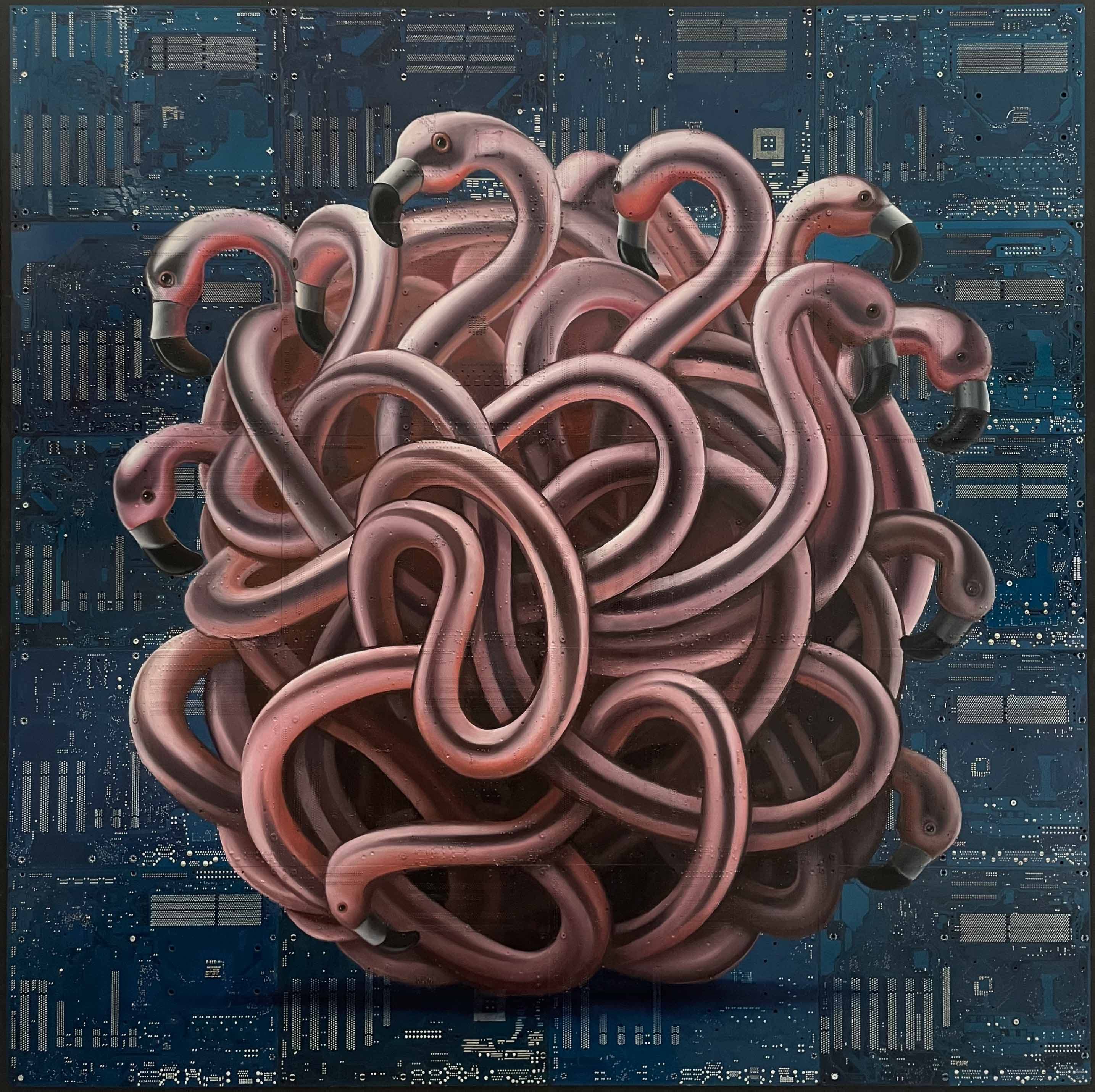
Born in 1980, Philipp Alexander Schäfer is an influential voice in Frankfurt's contemporary art scene. He explores the intersection of analog tradition and digital transformation in his works. He is known for his “City Ghosts” series, in which he combines oil painting on recycled computer circuit boards with critical reflection on our digital present. This series has earned him numerous awards.
How does the computer circuit board, a digital medium, change your relationship with the canvas, both technically and in terms of the message and resonance of your work?
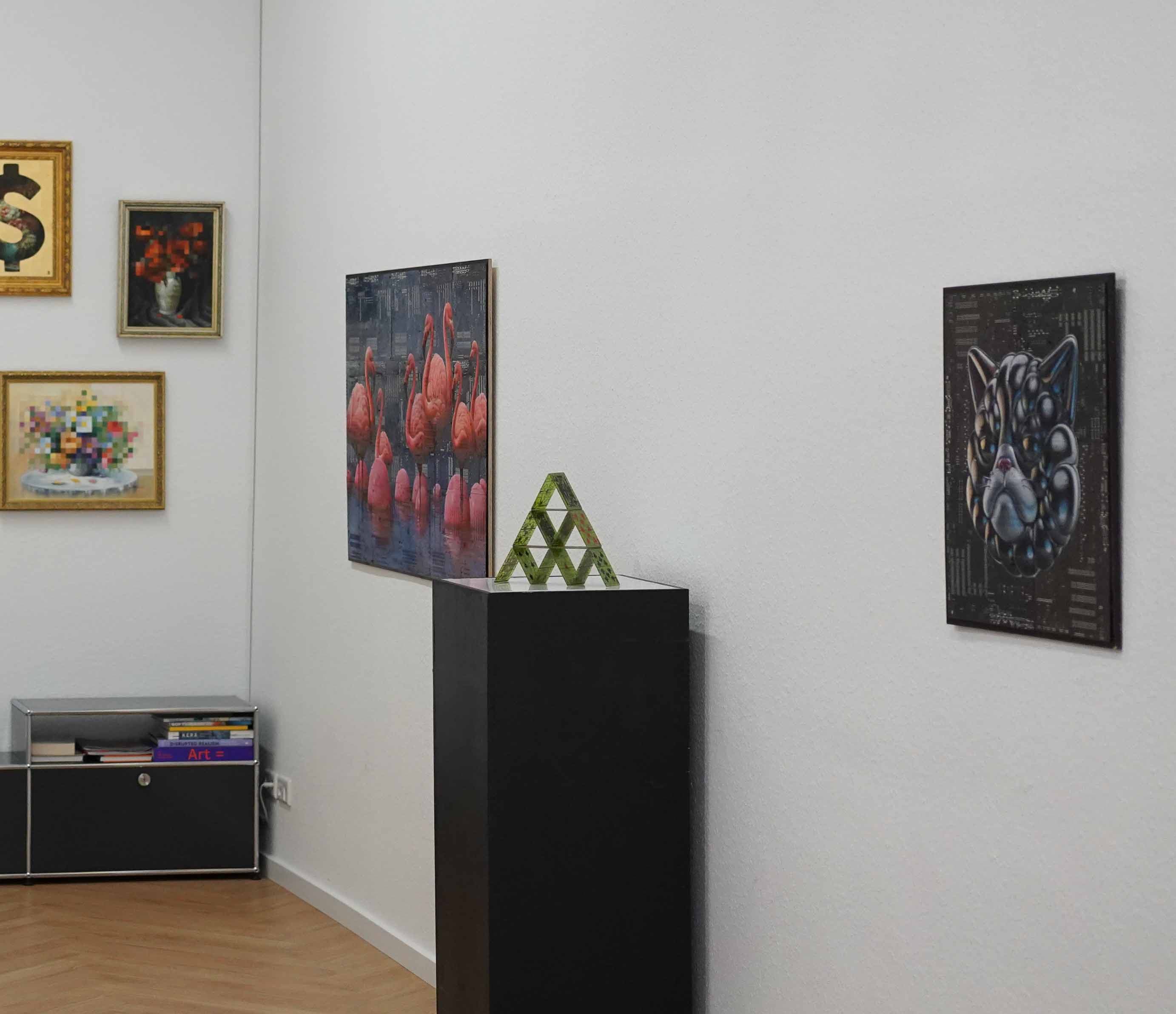
Philipp: Of course, the circuit board immediately has a connotation. It is not a clean canvas. It brings with it a level of meaning that one must be aware of. In my case, it wasn't the motifs that led me to the circuit board, but rather, it was the circuit board that led me to the motifs. It's a conceptual approach. I'm interested in circuit boards themselves, and then I experiment with painted motifs. I'm fascinated by circuit boards because of their relevance in today's world. They are one of the few objects that are so characteristic of our current era. In 20 or 30 years, they may no longer exist in this form because data will be stored differently. That's what makes working with them so exciting for me.
How do you find the motifs you put on these circuit boards? Do you have a set collection, or do you find suitable quotes or metaphors through inspiration?
Philipp: I've also been working with AI for a few years now, which is, of course, a new playground. In the past, it was more like inflatable swimming pool accessories. But there are motifs that recur. For example, I've painted flamingos on circuit boards several times. To me, they convey the feeling of an inflated paradise that can burst quickly, like a dream. This reflects the fact that the data on the circuit board is intangible; it's just ideas. I find many of my motifs in the digital world of social media. Grumpy Cat, for instance, or other short-lived internet phenomena.
Street art is fleeting and transient. Here, however, I want to create something that will outlive me. The two worlds are hardly comparable.
You shift between your roles as a street artist and an oil painter in your studio. Do these two worlds influence each other, or are they completely separate?
Philipp: There are similarities. I used to be fascinated by certain objects on the street, such as manhole covers, escalators, and electrical boxes. Now, circuit boards also spark my interest. In that sense, there are parallels. However, in terms of how I work, it's completely different. When I work on a painting for three and a half or four weeks, I'm much more intensely engaged with the subject. You go to sleep with it and wake up at night because you want to change something. For me, it's a much deeper engagement. Street art is fleeting and transient. Here, however, I want to create something that will outlive me. The two worlds are hardly comparable.
That brings me to my next question. You see yourself as a chronicler of the present. When people look back at your paintings in 30 years, what message do you want them to take away about our time? What message do you want to convey about our era on the circuit board?
Philipp: I want my art to reflect the present. Ideally, my work will provide deep insight into our time. Combining the motifs with the circuit boards can create a contemporary reflection. Of course, everyone perceives art differently, but I always want my work to touch people and trigger an emotion or reflection, which is often lacking in today's fast-paced life.
For me, it was essential to stop playing hide-and-seek. It's such an important part of who I am that I want to stand by my paintings, even if they were created illegally.
I think it's a nice contrast: digital art on the one hand, and craftsmanship on the other.
Philipp: Absolutely. This contrast is exciting because you take something from the world of data and electronic components and elevate it through painting, bringing it into the physical world. I did the whole graffiti and ghost story thing as a hobby for a long time. The real turning point was the Elfenbeinturm project (2013/2014), an eye-opening experience in which I realized that I could make a difference and change reality. I can really make a difference and change reality." From then on, I started working with street art, manhole covers, and escalators, and later circuit boards.
During our initial conversation, you briefly mentioned the importance of anonymity, which contrasts with your current clear commitment to your art.
Philipp: For me, it was essential to stop playing hide-and-seek. It's such a big part of who I am that I want to stand by what I paint, even if it was created illegally. Many graffiti artists create a second identity because they fear their art will suffer if they paint for money. But I think that's an excuse. For me, it was important to say: It's me. I want the exchange, and if you don't like it, so much the better! Tell me why. We can both benefit from the exchange!
Thank you very much for the interview Philipp!