
Interview with Christopher Kieling

Christopher Kieling (born 1988) is a Berlin-based painter who creates works of structural figuration. His aesthetic combines the precision of graphic design with the theatricality of stage design. Kieling's meticulously controlled canvases, which often employ a mix of acrylic and oil techniques, use geometric clarity to create psychological stage spaces. The Central Saint Martins University graduate gained international recognition with his “Sierra” series.
How did you get into art? Was there a key moment, or was it more of a series of moments that led you to pursue this path?
Chris: For me, art was a way to establish myself, show my work, and find my scene all at once. It has always been a part of me. I decided to pursue classical painting relatively late in life, actually only during or after my studies. I studied graphic design. It was exciting at first, but when I changed careers, I realized that it had nothing to do with my studies. It was dry, assembly-line work. However, I had always painted, and I developed a greater interest in classical art during that time. I told myself, "If everyday life is like this, I don't want it." I tried to focus on painting and surround myself with the right people. Over the years, I was able to make a living from it.
Your compositions are sometimes described as theatrical because you work with props, which appear arranged. To what extent has your background in graphic design sharpened your ability to stage or initiate a dialogue?
Chris: Graphic design is always helpful, if only for your web presence or social media. But I actually have a background in theater. My parents were stage actors. I spent a lot of time backstage and around stage sets as a child, and I think that's where my affinity for theater developed. It was also one of my first jobs after working at an agency. I moved to the theater where I grew up, and they let me work in props and help with stage construction. It was one of the most enjoyable jobs I've ever had because it was so varied and super exciting. The cultural aspect of the craftsmanship suited me very well. There was a great balance: painting and art during the day and rebuilding stages or setting up scenes in the evenings after 6 p.m. That had a huge impact on me. I am consciously aware that I incorporate this horizontal composition, arranging characters as a director would actors.
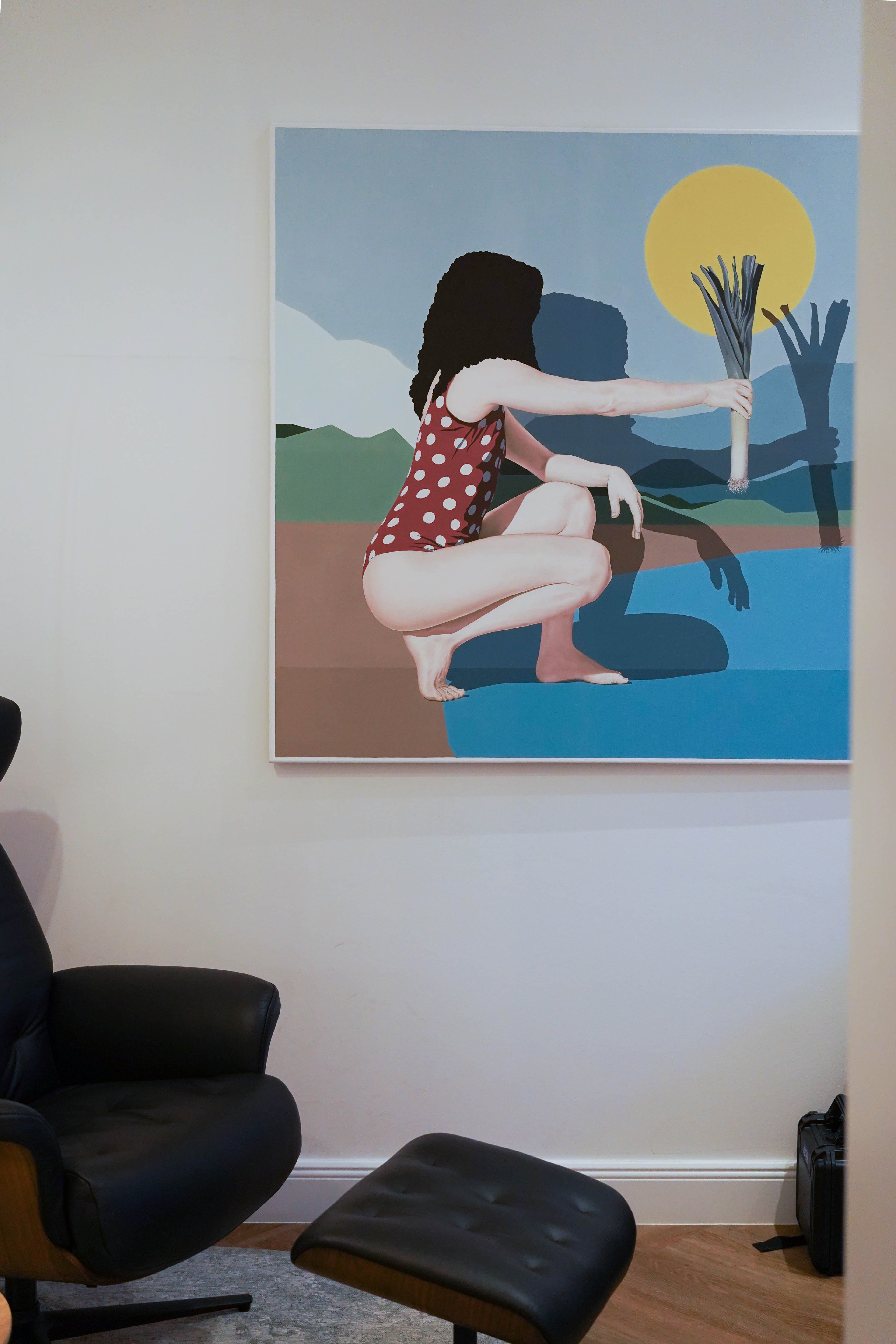
”I want to guide the viewer's eye across the canvas through colors and different elements. I put myself in the viewer's shoes and ask which elements attract the most attention to capture a certain dynamic of the eye.“
If someone described your painting as balancing the clarity of the design with the emotional power of the color application, how would you describe the process in the studio? Which aspect poses a greater risk: meticulously planning the composition or spontaneously painting?
Chris: I take a very methodical approach. That definitely comes from the field of design, planning things out. I create and switch between different compositions digitally in advance until I find something that works. Since I never studied painting, execution is always challenging. I wouldn't call it a “struggle,” but it is challenging to execute things the way I want. The biggest challenge is applying paint and finding the middle ground between free painting and my desired outcome. It's like realism; you try to get close to a reference, but you always fall short because a reference is just that—a reference. I find this constant challenge interesting.
The tension between meticulousness and freedom is exciting. If your art is meant to challenge, move, and enable new discoveries for viewers, what would your "stage directions" be for them to unravel the deepest layer of your painting? What do you want people to discover in your work?
Chris: I think that depends on the series. I've tried different approaches, such as the open markings of the Houston Road School, as seen in the work of Euan Uglow. I internalized that approach for a while to create a second level so that, in addition to the portrait, viewers can recognize a certain structure or train of thought. In other pieces, I try to create tension through the composition itself. I want to guide the viewer's eye across the canvas through colors and different elements. I put myself in the viewer's shoes and ask which elements attract the most attention to capture a certain dynamic of the eye.
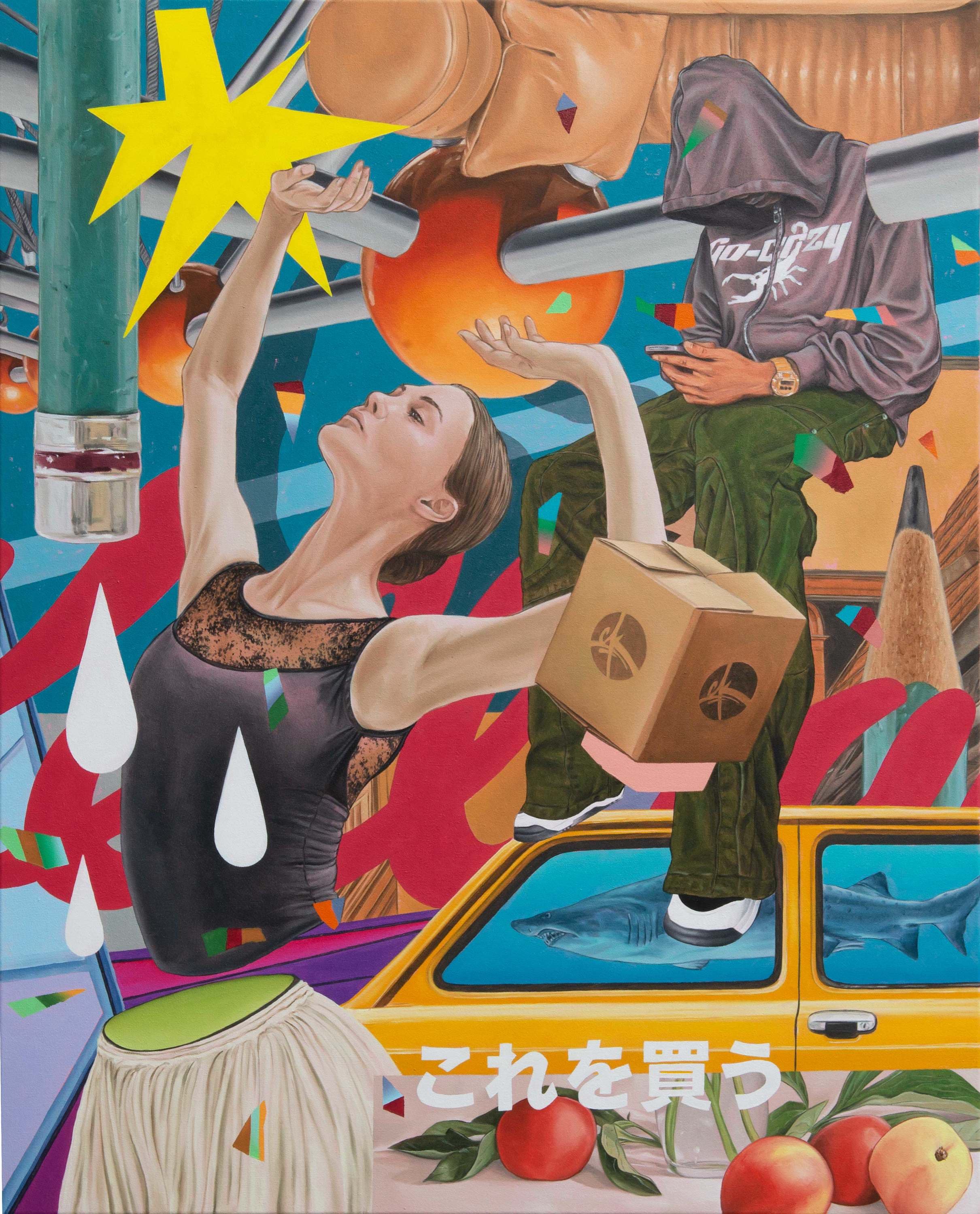
“For me, art and painting are incredible luxuries that allow me to change my mindset and do things my way. It's a freedom I don't want to give up.“
Are there any particular topics preoccupying you at the moment that you transfer onto the canvas?
Chris: I think it's constantly changing. I've been painting full-time for over ten years, and I always set myself themes or challenges. Currently, composition is always at the forefront, whether it's a simplified, minimalist composition revolving around a figure or posture for a year or a collage-like composition in which seemingly unrelated elements come together as a whole on the canvas. I think it's difficult to find a single common denominator. I express part of my creativity by remaining open and letting myself be inspired by the things that surround us all in life.
What is now on display in your gallery is a journey through time and the different phases of my painting career. This diversity tells a story. You can see a certain development, a journey you can take with me—from my earliest painting, from 2021, to my new works.
It's almost like a small retrospective. It's great that you're willing to do that because some artists don't want to display their older work alongside their newer pieces. However, it's exciting to see the complete body of work as a journey.
Chris: Yes, exactly. You could call it the Christopher Kieling universe.
I still consider myself young enough to not get completely stuck in one direction. Financially speaking, it might be smarter to do one thing until you become extremely well known for it. For me, though, art and painting are an incredible luxury. I love being able to change my mind and do things the way I want. It's a freedom I don't want to give up. I see myself as a craftsman. It's safe to say that graphic elements can be found in most of my paintings. I'm not a free painter who just paints without a plan; rather, I always have a plan. I love the interplay between flat, graphic elements and deeply realistic ones. This interplay is the common thread that runs through all my styles.
Thank you very much, Chris!
Recorded on October 31st 2025