Interview with Klara Landwehr
Klara Landwehr (born in 1987 in Haan, Rhineland) studied at the renowned Düsseldorf Art Academy as a master student of Professor Eberhardt Havekost and a student of Markus Lüpertz. In her works, she combines classical painting techniques with highly contemporary visual language.
Could you describe your studio or the place where your works are created?
Klara: It can be totally different. Whether with my family, with people close to me, or on vacation. Actually, it's not so much about the space itself. Only one thing matters: I need a wall measuring one to two square meters where I can hang a canvas. That's the main thing. Good lighting is super important, and if in doubt, it can also be done quite differently—with an easel.
Does that mean you have a specific theme that you start with? Or does the situation dictate the theme? How does that work with a new piece?
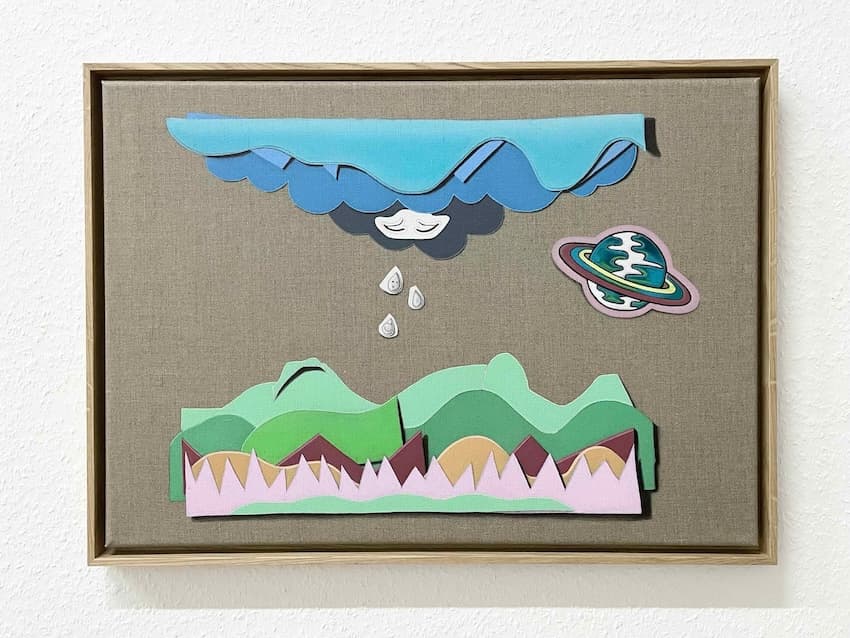
Klara: A new piece begins much earlier—inside me, in my emotional world. The actual painting is just one of the later steps. Images first emerge in an intuitive process. Most of the time, I sit down and start with a sketch. But not in the classic way with pencil and paper. Instead, I first recreate what will later go on the canvas on a small scale, using paper, cardboard, metal, plastic, anything I can get my hands on that inspires me.
Painting thus becomes an alternative reality, a counter-concept, a time-out with a focus on the healing, the good, and the joyful, also with a lot of wit and humor.
Would you say there is a moment in the process that is particularly important? Or are there several?
Klara: The moment I just described is the most important one for me. It is the point at which everything I want to express condenses within me and becomes visible for the first time, as a collage. That is where the core lies. Much of this happens unconsciously, completely intuitively. During the painting process, further decisions are made, and often what I had previously imagined changes. This also happens intuitively, in the moment, and I can sense exactly when something is allowed to take a different path.
And how would you describe the path that led you to your current style?
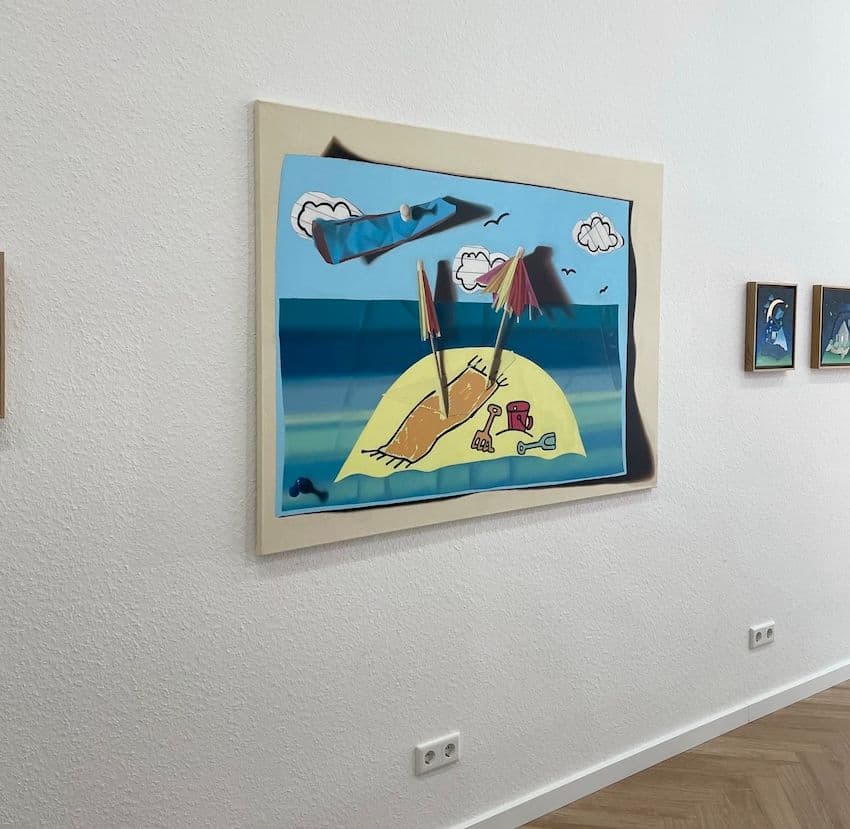
Klara: I started painting at art school with the desire to be able to paint everything as we see it, like the old masters. Using classic oil on canvas, I wanted to create a spatial illusion of reality on a two-dimensional surface. I worked on this throughout my studies in terms of the formal aspects. When I finally mastered this skill, I threw everything out the window and started painting abstractly and experimentally. I put my photorealistic skills aside and painted freely, without knowing what the picture would look like in the end. That was new for me, because before that I always had a clear idea of the result. After several years of working freely, both paths have converged again: knowledge of classical painting techniques and a playful, intuitive approach. This combination has given rise to what I paint today.
The inexpressible nature of painting, that which makes it unique, functions without language.
And if you had to briefly describe your art to someone who has never seen your paintings before—in a few words—what would you say?
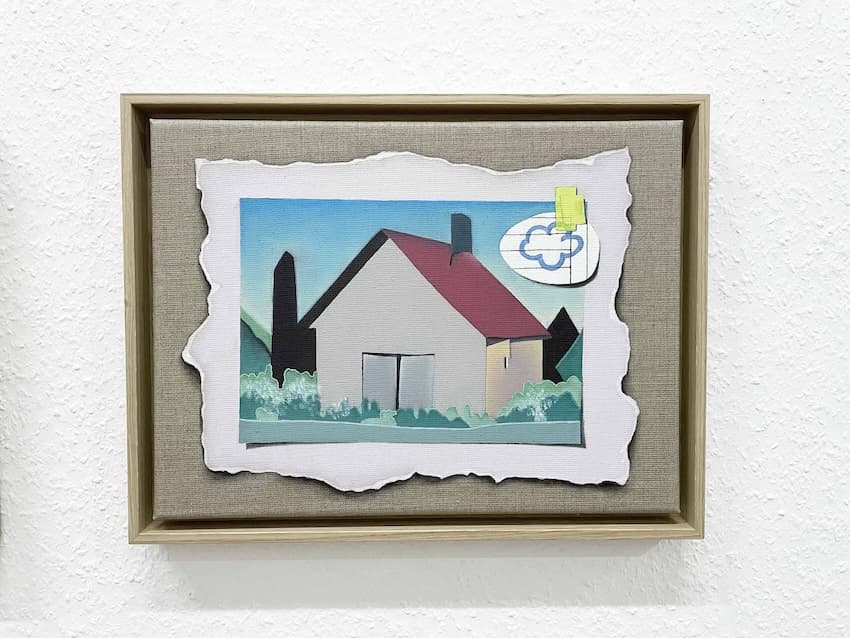
Klara: Hmmm... Describing art is always just a makeshift solution. I usually say “photorealistic, representational, landscape, plants, animals... or city.” But words are rarely enough. I prefer to show pictures, because art has to be seen. For me, it's crucial to stand in front of the picture and feel it. The indescribable nature of painting, that which makes it unique, functions without language. If words were enough, I would be a writer. The most important thing is that the pictures touch us, that we encounter each other and experience the pictures together.
Are there themes or emotions that recur in your works?
Klara: Definitely. Often, it's only afterwards that I realize what a picture might mean. I don't approach the canvas with a specific goal that I consciously want to express. I paint, and only later do I understand what's in it. Themes such as nostalgia, home, and longing appear again and again in my collages. Painting thus becomes an alternative reality, a counter-concept, a time-out with a focus on the healing, the good, and the joyful, also with a lot of wit and humor. Much of it has to do with looking back, with places or experiences that have left a deep impression on me and from which I draw inspiration. Weather phenomena, planets, and what happens in the sky also recur in my work. On the one hand, because they delight me and give me pleasure and joy. On the other hand, because for me they also represent emotions. They are a reflection of primal life. Much more exciting than my own interpretation in retrospect is what my pictures say to viewers, what they see and feel, what happens when I bring the pictures into the world.
Is there a particularly cool place where your works are displayed?
Klara: First of all, I think it's cool that my works are displayed in very different places—privately, in shops, in public spaces. But the coolest thing is that people around me have them around them—my partner, my best friend—real collectors, and my parents live in a Klara museum. That makes me especially happy. When a buyer chooses a work, a connection is made, they let me share in it, and it becomes part of their world—that's the greatest joy for me.
Thank you very much, Klara.
Recorded on August 23, 2025